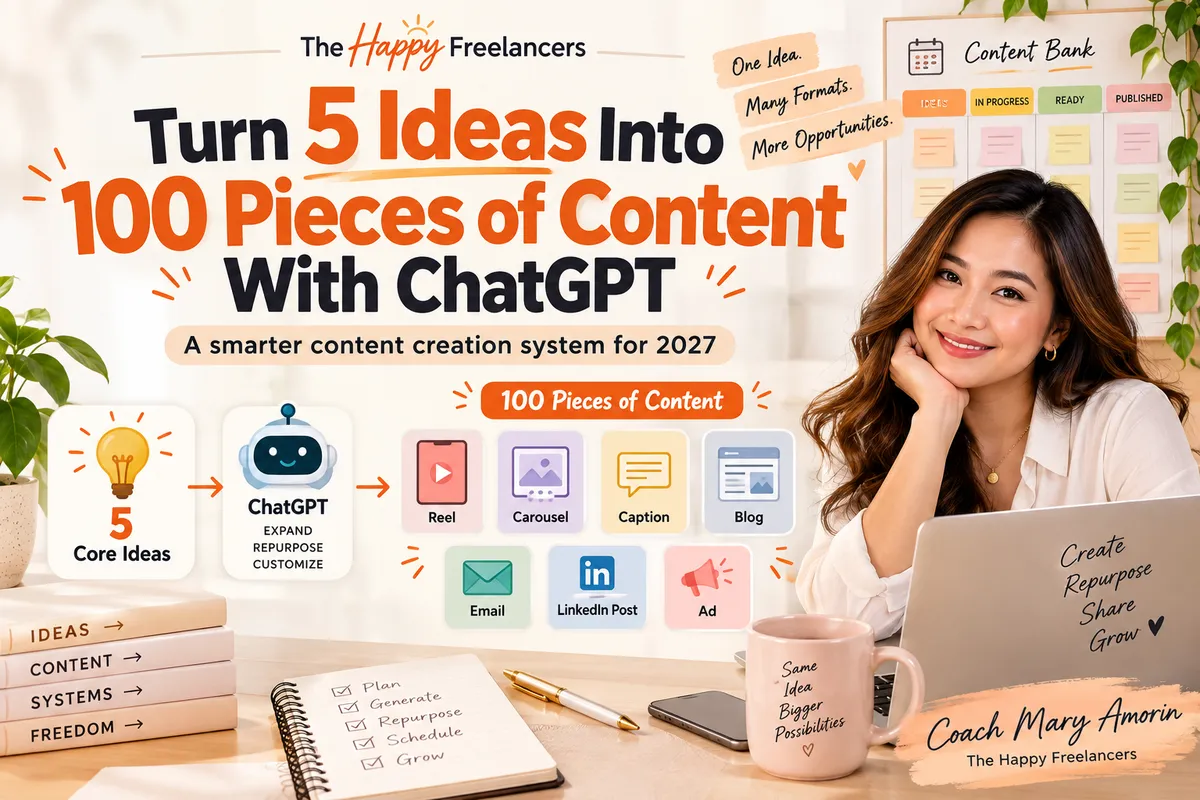
The 100 Content in One Hour Strategy
et me start with something that would have sounded crazy a few years ago.
You can now sit down with one good idea and create enough content for weeks, sometimes months, in about an hour.
😳 Yes, really.
But there is a catch.
You can also create 100 boring pieces of content in one hour.
And that is exactly where a lot of people are going wrong with AI right now.
They open ChatGPT and type:
“Give me 100 social media posts about marketing.”
Then ChatGPT gives them 100 posts.
Technically, the task is complete.
But strategically?
Not really. 😂
Because creating more content does not automatically mean creating better content.
🤖 AI Has Changed Content Creation Fast
AI is already deeply embedded in marketing workflows.
HubSpot’s 2026 State of Marketing found that 80% of marketers now use AI for content creation, while 75% use AI for media production.
Adobe found that 75% of creators now consider creative AI integrated or essential to their workflow, and 87% of creators using creative AI said it has helped grow their audience or business.
That means AI-assisted content is not some future thing anymore.
It is already happening.
But here is the interesting part.
HubSpot also found that while 71% of marketers say AI helps them create significantly more content, 53% are struggling to make their content stand out in a market now flooded with AI-generated material.
That is the real challenge.
We can create more.
But should we?
And if we are going to create more, how do we make sure it is still useful?
💡 The Value Is Moving Away From “Making Posts”
This is one of the biggest changes I see happening.
Before AI, a freelancer could say:
“I can create 30 social media posts for you.”
And that alone had value.
Now?
AI can help create 30 drafts in minutes.
OpenAI itself now recommends ChatGPT for campaign planning, content drafting, adapting one idea across multiple channels, generating variations, researching topics, and creating first-pass marketing assets. OpenAI
So the value is moving.
From:
“I know how to make posts.”
To:
“I know what content needs to be created, why we are creating it, who it is for, and how it supports the business.”
That is a very different skill.
And honestly?
That is good news for strategic marketers.
🧠 The Wrong Way to Create 100 Pieces of Content
Let me show you the mistake first.
You type:
Create 100 social media captions for my business.
ChatGPT will probably do it.
But you may end up with:
“5 Tips for Success”
“Stay Consistent”
“Believe in Your Brand”
“Here’s Why Marketing Matters”
“Are You Ready to Grow?”
😂
You know the type.
Generic.
Technically correct.
Completely forgettable.
The problem is not ChatGPT.
The problem is the input.
AI is very good at helping you expand thinking, structure ideas, create variations, and repurpose existing material. OpenAI specifically recommends using it as a thought partner rather than relying on one-shot prompts.
So instead of asking:
“Give me 100 posts.”
We need a system.
🔥 My 100-Content-in-One-Hour Strategy
Here is how I would do it.
We are not going to create 100 completely separate ideas.
That would be exhausting.
Instead, we create:
5 Core Topics
×
5 Angles per Topic
×
4 Content Formats
And suddenly:
5 × 5 × 4 = 100 pieces of content.
Much easier.
And much more strategic.
Let’s break that down.
Step 1: Choose 5 Core Topics
Your core topics should come directly from what your audience actually needs help with.
For example, if I am targeting freelancers who want to improve content marketing, my five topics might be:
Content strategy
Lead generation
AI content creation
Funnels
Client acquisition
That is already enough.
Do not start by trying to think of 100 topics.
Start with FIVE.
Prompt:
I am creating content for [describe your audience].
My main offer is [describe your offer].
Their biggest problems are [list problems].
Give me 5 core content pillars that directly connect their problems to my expertise and offer.
Avoid generic topics. Make each pillar specific enough to create educational, authority-building, and lead-generation content around it.
Now review the answers.
Do not automatically accept everything.
Change anything that does not sound like you.
Step 2: Turn Each Topic Into 5 Angles
This is where the magic starts.
A single topic should never equal a single post.
Let’s use:
AI Content Creation
Now we can create five angles.
Angle 1: Mistake
“Why Asking ChatGPT for 30 Captions Usually Creates Generic Content”
Angle 2: How-To
“How to Turn One Blog Into 20 Pieces of Content”
Angle 3: Opinion
“AI Is Not Replacing Good Content Marketers. It Is Replacing Repetitive Work.”
Angle 4: Myth
“You Do Not Need 30 New Ideas Every Month”
Angle 5: Case/Example
“How One Business Idea Can Become a Reel, Carousel, Blog, Email, and Ad”
Now one topic became five conversations.
Do that for all five topics.
You now have:
25 content ideas.
Prompt:
Take this content topic: [TOPIC].
Create 5 completely different content angles using:
common mistake
how-to
strong professional opinion
myth or misconception
practical example or case scenario
My audience is [AUDIENCE].
Keep the ideas specific, useful, and connected to real problems.
Avoid clickbait and generic motivational content.
Step 3: Turn Every Idea Into 4 Formats
Now we have 25 ideas.
Instead of creating 75 more new ideas, we repurpose.
Each idea becomes:
1. Short-form video
2. Carousel
3. Social media caption
4. Long-form post or mini-blog
25 × 4 = 100.
Done.
This is the difference between content creation and content expansion.
You are not constantly thinking from zero.
You are taking one useful idea and expressing it in different ways.
OpenAI’s own marketing guidance recommends exactly this type of workflow: adapting the same core message across audiences, channels, and formats rather than recreating everything manually.
Prompt:
Take this idea:
“[CONTENT IDEA]”
Turn it into four separate content assets:
A 45-second Reel/TikTok script with a strong hook and natural speaking tone.
A 5-slide LinkedIn or Instagram carousel. Slide 1 should create curiosity. Slides 2–4 should teach. Slide 5 should give a practical takeaway.
A conversational social media caption that teaches something useful without repeating the video script.
A 500-word educational LinkedIn post or mini-blog expanding the idea.
Audience: [AUDIENCE]
Tone: [YOUR TONE]Do not make the four assets sound identical. Each one should feel native to its format.
🕐 Can You Really Do This in One Hour?
Yes, but there is an important distinction.
You can create 100 usable first drafts or content concepts in one focused session.
That does not mean you should publish all 100 without review.
OpenAI specifically recommends treating ChatGPT outputs as drafts that need human review for accuracy, nuance, tone, and final approval.
My one-hour workflow would look something like this:
First 10 minutes:
Define audience, offer, goals, and five core topics.
Next 10 minutes:
Generate five angles for each topic.
Now you have 25.
Next 30 minutes:
Generate four formats per idea.
Now you have 100.
Final 10 minutes:
Review, remove weak content, flag the strongest ideas, and organize them into your content bank.
You are not spending the whole hour writing.
You are spending the hour directing the content system.
And that is very different.
📦 Step 4: Create a Content Bank Instead of Posting Everything
Please do not create 100 posts and immediately schedule all of them. 😂
The better move is to build a content bank.
You can organize them into:
Category | Purpose |
|---|---|
Awareness | Helps new people discover you |
Education | Teaches something useful |
Authority | Shows experience and thinking |
Conversation | Encourages response |
Lead Generation | Moves people toward a resource |
Conversion | Addresses objections and next steps |
Now you have a library.
When you need content next week, you are not starting from zero.
You already have material.
🎯 Step 5: Add a Business Purpose to Every Piece
This is where I think people using AI need to slow down.
Before creating a post, ask:
What is this supposed to do?
Not every post should sell.
But every post should have a role.
For example:
Awareness
Introduce a problem.
Education
Explain the problem.
Trust
Share your experience.
Conversation
Ask for their perspective.
Lead generation
Send them to your lead magnet.
Conversion
Help them understand the offer.
This is what stops AI content from becoming random noise.
Prompt:
Review these 25 content ideas and classify each one into one of these purposes:
Awareness
Education
Authority
Conversation
Lead Generation
ConversionMake sure the entire content set is balanced.
If one category is overrepresented, suggest replacements.
🗣️ Step 6: Add Your Voice Before Publishing
This is important.
AI should not erase you.
If anything, it should make it easier for you to express more of your thinking.
Adobe’s 2026 research found that 85% of creators believe the final creative decision should remain human.Adobe Newsroom
I agree with that.
So before publishing, I would add:
✅ My stories
✅ My examples
✅ My client observations
✅ My opinions
✅ My phrases
✅ My humor
✅ My Filipino context when relevant
✅ My actual experience
This is why two people can use the exact same AI tool and produce completely different quality.
The tool is the same.
The thinking is not.
🎤 Prompt: Make It Sound More Like Me
You can use a prompt like this:
Rewrite this content in my voice.
My style is:
conversational but knowledgeable
educational, not preachy
practical
sometimes playful
uses real examples
avoids corporate jargon
avoids generic motivational statements
Keep my main idea intact.
Add one relatable example and one strong takeaway.
Do not make the writing sound overly polished or robotic.
Even better?
Give ChatGPT examples of your previous content.
OpenAI recommends providing reference material, previous writing, tone guides, or strong examples when you want more consistent brand output. OpenAI
🗂️ Step 7: Use ChatGPT Projects for Your Content System
One current ChatGPT feature that is especially useful for content work is Projects.
Projects allow you to keep related chats, files, instructions, references, and context together instead of starting from scratch each time. OpenAI specifically lists content creation and recurring writing workflows as common uses. OpenAI
For example, create a Project called:
“My 2027 Content Bank”
Inside it, add:
Your brand voice
Audience description
Offers
Previous high-performing posts
Content pillars
Lead magnets
Blog articles
Testimonials
Frequently asked questions
Competitor notes
CTA rules
Then add project instructions like:
You are my content strategy assistant.
Always create content based on my brand voice, audience, business goals, and existing content pillars.
Do not create generic motivational content.
Prioritize useful observations, practical examples, education, lead generation, and strong original perspectives.
When repurposing, preserve the original idea but adapt the execution for each platform.
Now every session starts with context.
You are not teaching ChatGPT your business again every Monday. 😂
🔄 Step 8: Repurpose What Already Works
This might be my favorite part.
Before asking:
“What new content should I make?”
Look at what already worked.
Take:
Your best Reel
Your strongest LinkedIn post
Your webinar
Your ebook
Your blog
Your FAQ
Your client questions
Then ask AI to expand them.
Example:
One webinar can become:
🎥 10 short videos
🎠 5 carousels
✍️ 10 captions
📧 5 emails
📝 3 blogs
💼 5 LinkedIn posts
🧲 1 lead magnet
📣 3 ad concepts
One piece of long-form content can feed an entire campaign.
This is where AI becomes incredibly useful.
Not as an idea vending machine.
As a content multiplier.
🔍 Step 9: Add Research Before You Publish
This matters even more now.
AI can help you generate quickly, but speed makes it easier to accidentally publish outdated or incorrect information.
OpenAI's writing guidance recommends verifying facts, numbers, policies, and claims before using them. OpenAI
So for educational content, use this workflow:
Idea
↓
Research
↓
Draft
↓
Human insight
↓
Fact check
↓
Publish
Not:
AI
↓
Copy
↓
Post
😂
🌐 Step 10: Think Beyond Google SEO
There is another interesting shift happening.
Content Marketing Institute now specifically discusses optimizing content not only for traditional search engines but also for AI-powered discovery tools such as ChatGPT, Gemini, and Copilot.
Adobe reports that 48% of organizations are already optimizing content to be interpreted and surfaced by AI-powered discovery tools.
So the future of content is not only:
“Can Google find it?”
We also need to think:
“Can AI understand it?”
That means content should increasingly include:
✅ Clear explanations
✅ Useful headings
✅ Specific examples
✅ Definitions
✅ Original insights
✅ Reliable sources
✅ Structured information
✅ Real expertise
Basically?
Create content that is actually worth referencing.
Learn more about the new content marketing stratgegy for 2027: The New Lead Generation Strategy for 2027: Content Alone Is Not Enough
🚨 The Problem With AI Content Is Not AI
It is lazy strategy.
If everyone has access to the same tools...
Then the advantage is no longer simply access.
It becomes:
Who asks better questions?
Who understands their audience?
Who has better insights?
Who creates stronger systems?
Who knows what information matters?
Who adds real experience?
That is why I keep saying:
AI can help you create faster.
But your brain still decides what deserves to be created.
🧡 My Final Rule for Creating 100 Pieces of Content
Do not start with:
“I need 100 posts.”
Start with:
“I need five ideas worth talking about.”
Then expand them.
That simple shift makes a massive difference.
Your workflow becomes:
5 Core Topics
↓
25 Strong Angles
↓
100 Content Assets
↓
Organize by Purpose
↓
Add Your Voice
↓
Review and Fact Check
↓
Publish Strategically
That is how I would use ChatGPT for high-volume content creation.
Not to replace thinking.
To multiply it.
And THAT is where AI gets powerful.
If you want, this would also make a strong second Beyond Content 2027 blog, because it naturally leads into the bigger idea:
AI helps us create more. Strategy tells us what is worth creating.
XOXO
Coach Mary Amorin
The Happy Freelancers